
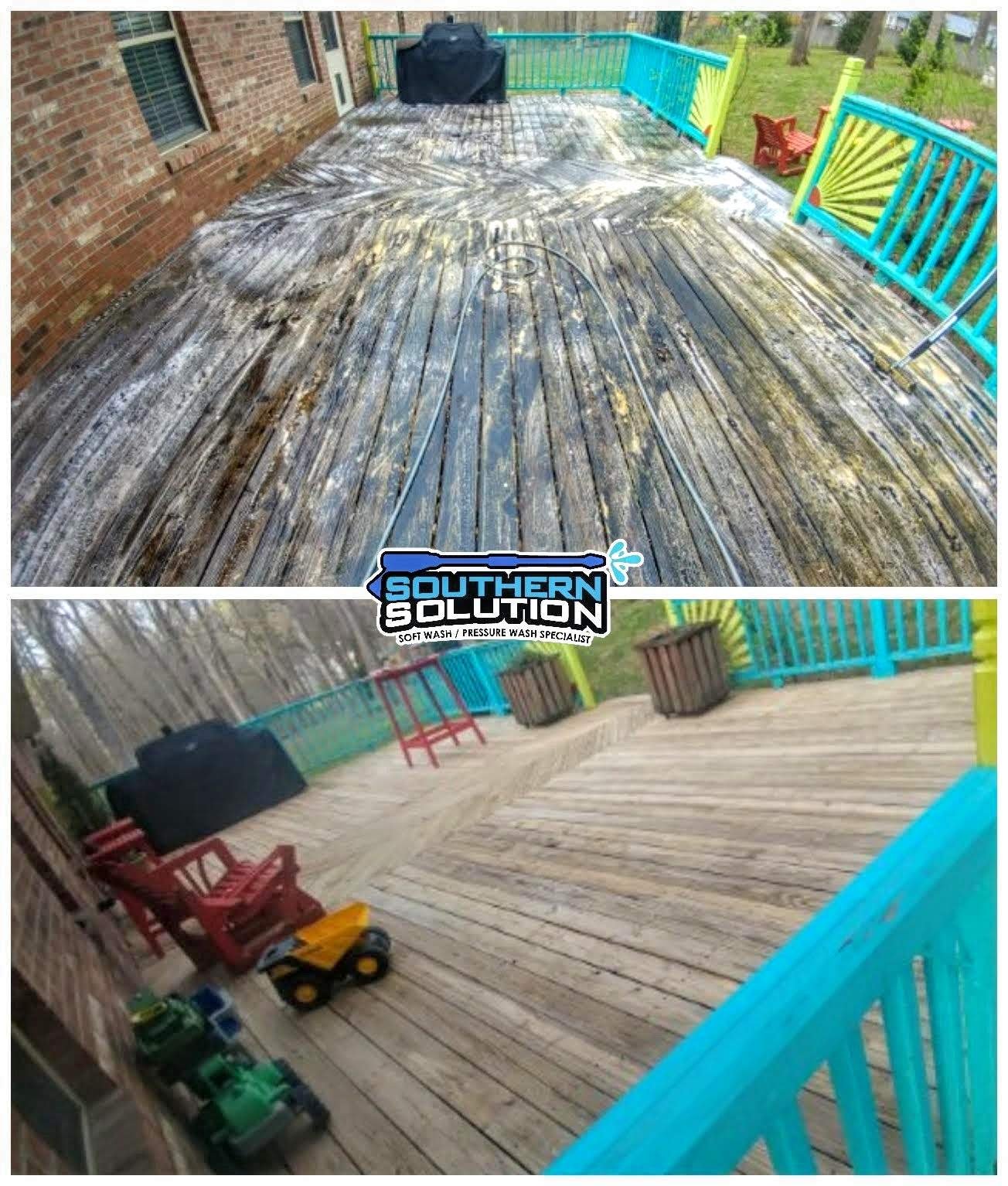
Wood Restoration That Brings Gray Decks Back to Life
That faded gray is not dirt. It is UV breaking down the wood fibers themselves. Our three-step wood restoration strips the failed finish, kills the growth, and brightens the grain so a new stain actually holds.
Wood Restoration in Middle Tennessee: Quick Answers
- Wood restoration is a three-step process: clean or strip, low-pressure rinse, then brighten.
- Wood restoration costs far less than replacing a deck, and most weathered decks are fully restorable.
- A maintenance clean runs $0.30 to $0.35 per square foot, and a full strip and brighten runs around $1.00.
- A full restoration of strip, sand and stain typically runs $6 to $9 per square foot.
- Fence staining starts at $3.00 per linear foot, and full fence restoration runs $5 to $7.
- The chemicals do the work, not the pressure. High pressure permanently furs soft wood.
- Brightening with oxalic acid is the step amateurs skip, and it is why their stain fails.
- Middle Tennessee decks need cleaning and sealing every two to three years.
- Trex and composite decking need composite-safe chemistry and pressure under 1,500 PSI.
See Wood Restoration Happen Under Your Finger
Drag across the wood below and take the weathering off. Real before, real after, real Middle Tennessee job.
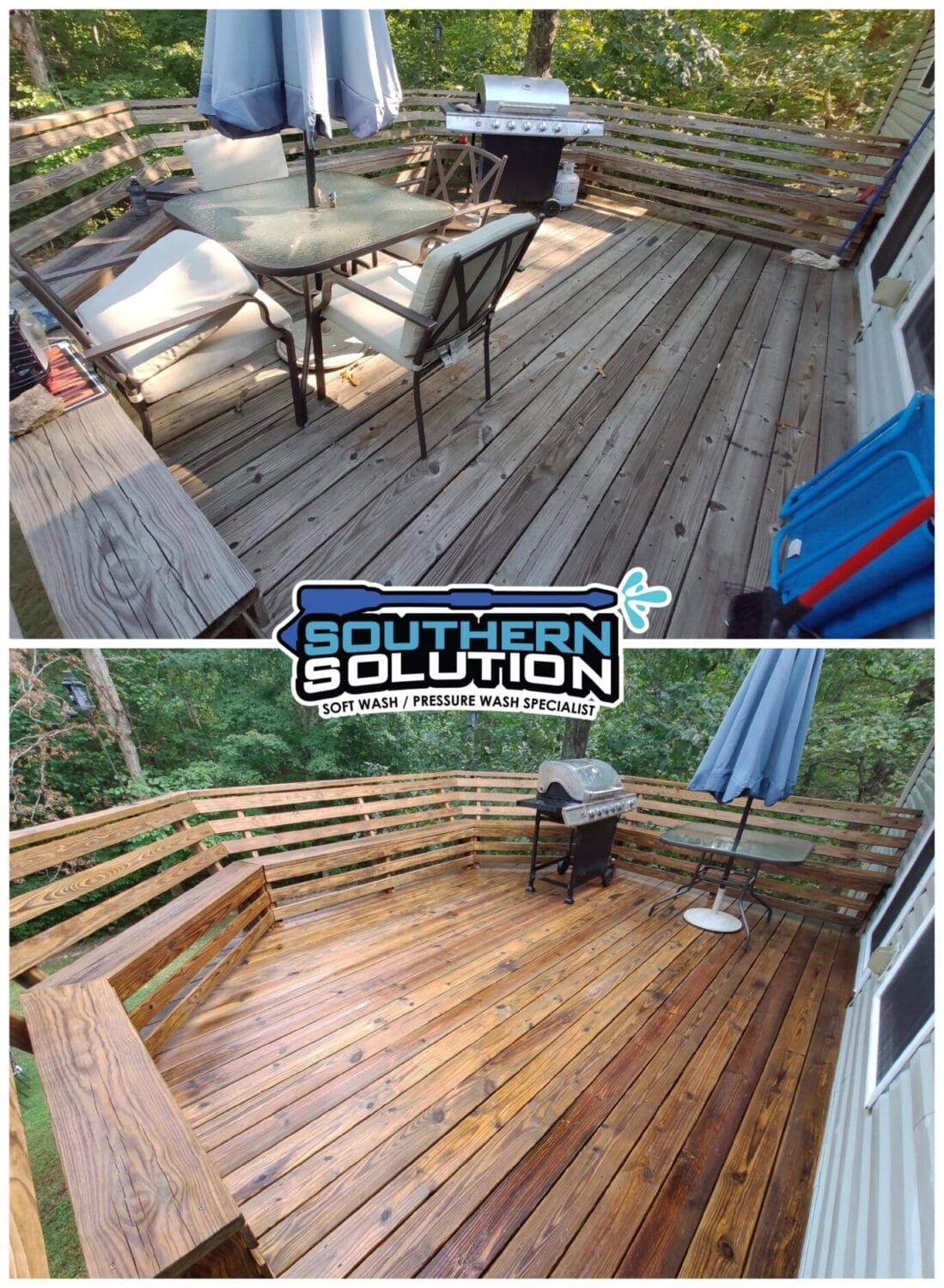 Before
After
Before
After
A real Nashville deck, shot from directly overhead. That gray layer is dead wood fiber, and it comes off chemically. Blasting it away with pressure takes good wood with it.
Price Your Wood Restoration in Under a Minute
The water test above decides most of your price. Answer that plus a few dimensions and you will see a real range before you talk to anybody.
Most people booking a strip also want stain, since bare wood should not sit exposed for long.
Clean versus strip is a three times price difference, and the only way to be certain is to look at the wood. Attach two or three and your quote stops being a range and becomes a number.
- A wide shot of the whole deck or fence
- A close-up of the worst area, peeling or gray
- The railing or steps, if you have them
Photos are optional, but a quote with photos is a number instead of a range.
Got it. Your estimate is on the board.
📸 Want an exact number instead of a range?
You did not attach photos, which is fine. If you change your mind, tap below and an email opens with all your details already filled in. Just attach and send.
- A wide shot of the whole deck or fence
- A close-up of the worst area, peeling or gray
- The railing or steps if you have them
Why Middle Tennessee Wood Restoration Is Different
Wood restoration here has to account for constant UV, humidity and rain that decks, fences and porches take year round. That faded gray look is not cosmetic. It is a sign the wood's natural defenses are breaking down.
☀UV Breaks Down Lignin
Ultraviolet light destroys lignin, the natural glue holding wood fibers together. That is what turns wood gray, and it also makes the surface brittle and prone to splintering underfoot.
What we do: chemically remove the dead gray fiber layer, then brighten the sound wood underneath back to its natural tone.
💧Algae and Mildew Take Hold
Green and black growth thrives on damp, porous wood. It is a real slip hazard on stairs and decking, and it accelerates rot by holding moisture against the boards.
What we do: kill it at the root with the correct chemistry rather than scrubbing the surface layer off and leaving the spores.
🔨Failed Sealant Traps Moisture
Old peeling sealant is worse than no sealant at all, because it holds water against the wood instead of shedding it. That is how soft spots, rot and structural failure start.
What we do: strip the failing coating completely rather than recoating over it, which is the single most common reason a stain job fails in one season.
🌿Tannin Bleed and Staining
Cedar and redwood release tannins that leave dark streaks, and metal fasteners bleed rust into the surrounding grain. Neither one washes off with soap and water.
What we do: oxalic acid lifts both tannin and rust staining out of the wood, which is the same chemistry that brightens it.
⚠High Pressure Furs the Grain
The most common damage we get called to fix is not weather, it is a previous cleaning. Too much pressure raises the wood fibers into a fuzzy, splintered surface that then traps dirt worse than before.
What we do: low-pressure rinse with fan tips at a controlled distance, and sanding afterward when furring is already present.
💰Replacement Costs Many Times More
A deck that is dirty and gray is almost always restorable. A deck that has been left until the boards are soft and the fasteners are pulling is a rebuild, and the price gap between those two states is enormous.
What we do: tell you honestly which one you have. If boards are past saving we will say so instead of taking the job.
Our Three-Step Wood Restoration Process
We do not simply pressure wash wood. That causes damage you cannot undo. This is a chemical process with a gentle rinse, designed to clean, restore, and prepare the surface for a finish that actually lasts.
Deep Clean & Strip
A professional-grade wood cleaner or stripper goes on first, formulated to break down failed sealant, release the dead gray fiber, and kill organic growth deep in the pores. We agitate gently so it penetrates evenly instead of blotching.
Low-Pressure Rinse
Once the chemistry has done its work, a controlled low-pressure rinse carries away the grime, dead fiber and old coating. Fan tips at a measured distance, never a concentrated stream, so the grain never furs.
Brighten & Neutralize
The step amateurs skip. An oxalic acid brightener returns the wood to a neutral pH after an alkaline clean, reopens the pores so new stain can penetrate, and restores the natural warm tone. Skip it and the stain goes on muddy and fails early.
Wood Restoration for Every Outdoor Surface
Wood restoration is not one method. Different materials need different chemistry and different pressure. Using one approach on all of them is how decks get ruined.
Oil-stained deck, stripped and brightened. Same boards, same angle.
Wood Deck & Patio Restoration
Applying stain over a dirty, weathered deck is like painting over rust. It is guaranteed to fail. Our process makes sure the new sealant penetrates the pores properly, which is the difference between a finish that lasts years and one that peels next summer. We handle every deck type common around Nashville:
- Pressure-treated pine
- Cedar and redwood, including tannin bleed
- Exotic hardwoods like Ipe and teak
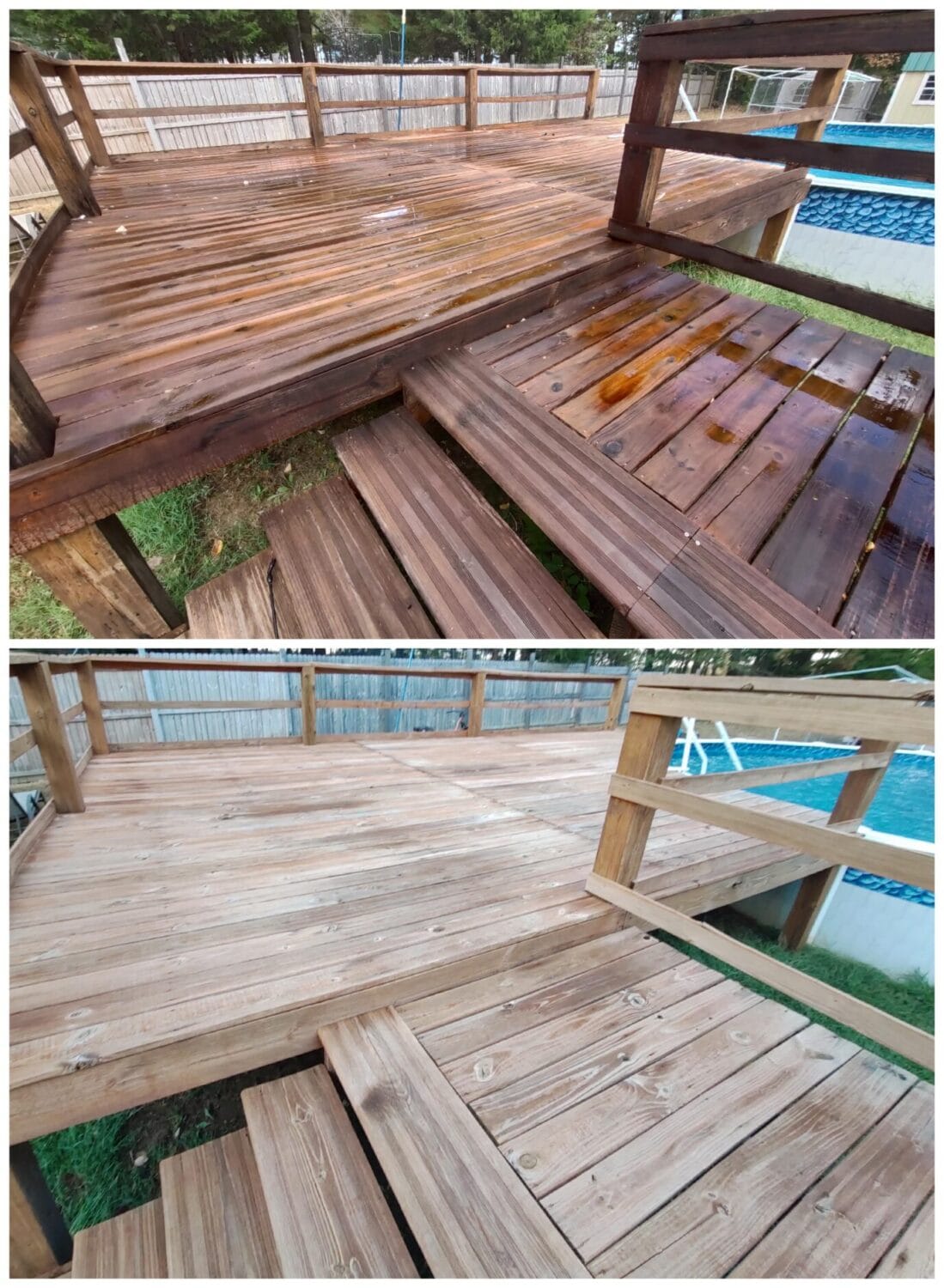
Before cleaning, and after cleaning plus a fresh stain.
Fence Cleaning & Brightening
A weathered gray fence drags down the look of an entire property, and it is usually the longest continuous surface a neighbor sees. Our fence service removes years of built-up grime and organic growth, then brightens the wood back toward its natural color. On vinyl fencing, a soft wash lifts green algae and black mildew without the pressure that dulls the surface. It is one of the most cost-effective improvements available on a property line.
Trex decking at a Nashville apartment complex, cleaned composite-safe.
Trex & Composite Deck Cleaning
Composite decking still grows algae, mold and mildew, which stains it and makes it slick. High pressure permanently scars these materials in a way that cannot be sanded out. We use composite-safe detergents and controlled pressure following the guidance published by manufacturers like Trex, so the deck comes back without the swirl marks that come from too much force.
One Deck, Start to Finish
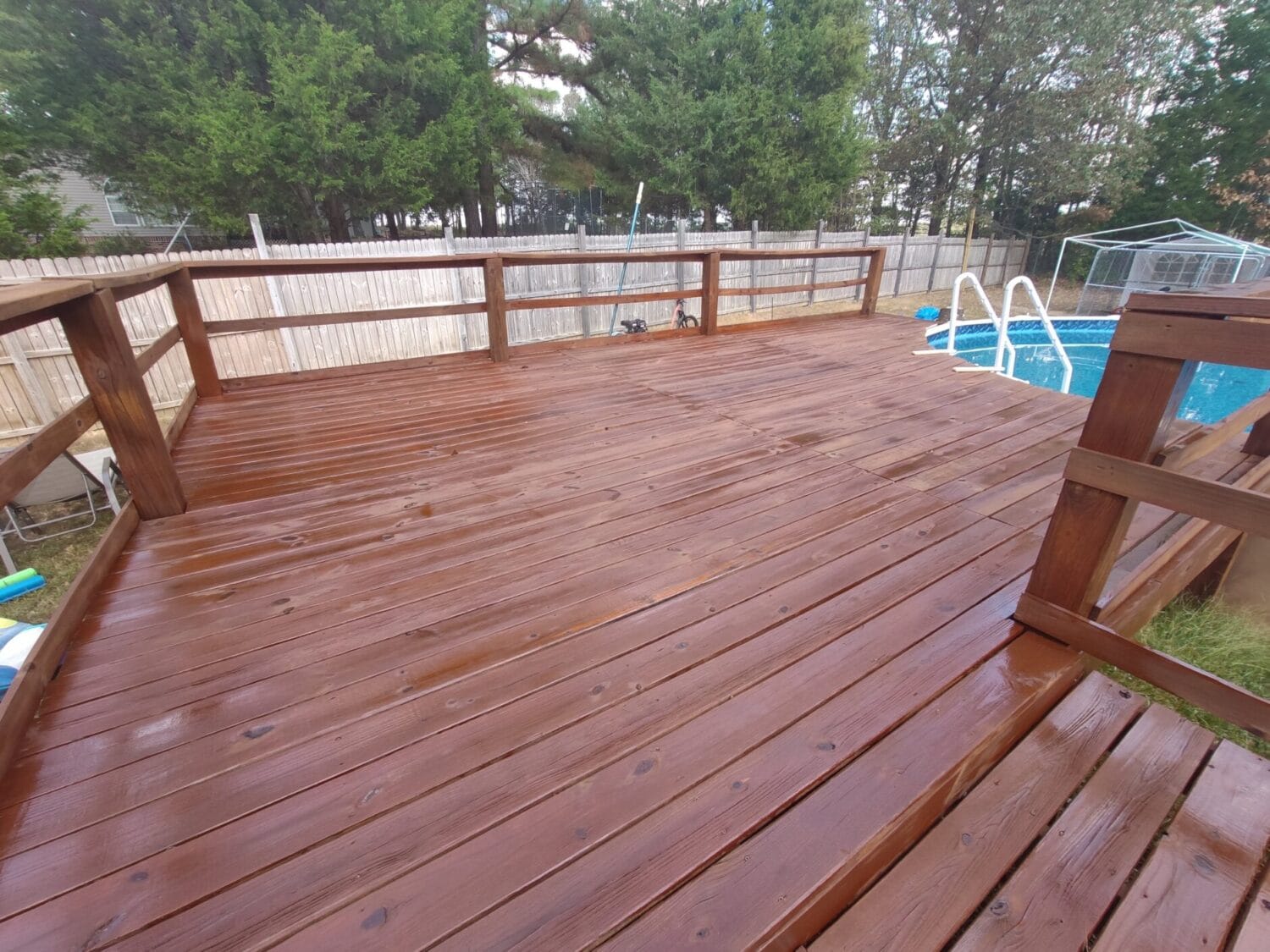
Two separate photographs of the same deck. The first was taken mid-strip, pulling a failed oil-based stain off the boards. The second was taken after brightening, sanding and a fresh coat went down. This is what a full restoration actually looks like from the inside.
The Definitive Guide to Wood Restoration
This is the expert-level detail that separates real wood restoration from a damaging pressure wash. If you want to understand what you are paying for, or you are a contractor learning the trade, it is all here.
It is chemistry, not pressure
The number one rule of wood restoration is that the chemicals do the work and the pressure does not. High pressure permanently damages soft woods like pine and cedar, causing furring and splintering that no amount of stain will hide. We select the right chemical for the specific situation to break contaminants down at a molecular level, then rinse gently.
- For organic growth: on unsealed or lightly sealed wood we start with a buffered sodium hypochlorite solution, or a gentler oxygen-based cleaner like sodium percarbonate. Both kill algae and mildew at the root rather than just lifting the visible layer.
- For failed sealer and heavy oxidation: a calibrated sodium hydroxide solution dissolves old failing sealant and deeply embedded grime that a cleaner alone will not touch.
- Dwell time matters more than strength: a correctly mixed product left to work beats an over-strong mix rushed off the surface, and it is far safer for the wood.
Removing the old to make way for the new
When a previous paint or stain is peeling, flaking or chipping, you cannot simply clean and recoat. The new finish will fail, usually within a season. This process is more intensive and is about creating a sound canvas.
- Stripping agent: a professional sodium hydroxide-based stripper fortified with surfactants and a butyl solvent, which breaks the chemical bonds of the old coating.
- Manual removal: scrapers and wire brushes on loose and flaking material. The goal is not bare wood everywhere, it is removing 100 percent of the failing coating.
- Controlled rinse: low pressure to carry away the stripper and dislodged chips without driving them into the grain.
Why this is the step amateurs skip
After cleaning or stripping with an alkaline chemical, the wood surface sits at a high pH and the pores are closed and dark. Apply stain at that point and it will not absorb properly, and the color comes out muddy. A wood brightener, typically oxalic acid based, is what fixes it.
- Returns the wood to neutral pH: preventing the chemical reaction that makes a new stain fail early.
- Opens the grain: so the new stain or sealant penetrates deeply and evenly rather than sitting on top.
- Restores natural color: lifting the dark pulpy look left after stripping, along with tannin and rust staining.
The finish nobody sees but everybody feels
The chemical process, while necessary, can raise wood fibers slightly. Sanding is the final step in a true restoration, especially after stripping.
- Removes furring: sanding away raised fibers leaves a smooth, splinter-free surface that is safe for bare feet.
- Ensures even absorption: a uniformly sanded surface takes stain consistently instead of blotching.
- Prepares a flawless canvas: whether we are staining it or you are, this is what makes the difference between a good result and a professional one.
What each product actually does
| Chemical | Primary use |
|---|---|
| Sodium percarbonate | Gentle cleaner for unstained wood, removes dirt and mildew |
| Sodium hydroxide | Aggressive stripper for oil-based stains and heavy oxidation |
| Oxalic acid | Brightener, removes rust and tannin staining, neutralizes strippers |
| Citric acid | Safer alternative brightener for exotic woods like Ipe |
| Sodium metasilicate | Boosts cleaning power and helps reveal wood grain |
| 2-Butoxyethanol (butyl) | Solvent booster used in stripping mixes |
Wood-specific notes
- Ipe and exotic hardwoods: brighten with citric acid. Stains rarely hold on these, so a light oiling is usually the better call.
- Teak: prone to turning black from linseed-based oils in Tennessee humidity, and needs a specific approach.
- Cedar and redwood: prone to furring and tannin bleed. Gentle pressure and an oxalic brightener.
- New wood: often needs brushing or a light sanding to remove mill glaze before it will accept a finish at all.
- Older Trex before roughly 2010: non-encapsulated, with exposed wood fiber. Sodium percarbonate followed by an oxalic brightener prevents dark spotting.
- Newer Trex: encapsulated and far more durable. A composite-specific cleaner at low pressure is all it needs.
⚠ Professional use only, please read
The mix below is working knowledge for licensed contractors and is published so the trade can learn, not as a DIY instruction. Sodium hydroxide causes severe chemical burns to skin and permanent eye damage. Full PPE means chemical-resistant gloves, sealed goggles and a respirator, every time.
Never combine sodium hypochlorite with any acid, including the oxalic acid brightener described above. That combination releases chlorine gas and it can be fatal in an enclosed space. Rinse thoroughly and allow the surface to dry between the alkaline and acid stages.
If you are a homeowner reading this: the honest advice is to let a professional handle it. The chemicals are the dangerous part, not the machine.
2 gal sodium hypochlorite at 12.5%
12 oz sodium hydroxide powder
6 to 8 oz butyl degreaser / surfactant
water to approximately 4.5 gallons
The Wood Restoration Owner's Guide to Coatings
Preparation is most of any wood restoration, but the finish you choose is what protects the investment. Here are the honest trade-offs on each of the four options, including the maintenance nobody mentions at the point of sale.
💧Clear Wood Sealers
Non-pigmented and built for one job: keeping water out. The grain and character show through completely, but with almost no UV protection, so the wood will still gray over time.
- Best for
- Newer decks where the point is showcasing natural cedar or redwood while protecting against water.
- Longevity
- 1 to 2 years
- Maintenance
- The easiest of the four. Usually just a light cleaning before recoating, since there is no pigment to strip.
🎨Oil-Based Semi-Transparent
The traditional choice. Penetrates deep into the pores, nourishes the wood and repels water well, while leaving the grain visible under a rich color.
- Best for
- A classic look on decks and fences, and particularly good at conditioning older, drier wood.
- Longevity
- 2 to 4 years
- Maintenance
- Recoating needs thorough prep. A full strip and brighten is usually necessary to avoid a blotchy finish.
🌿Water-Based Semi-Transparent
Modern acrylics have come a long way. Rather than penetrating, they form a protective film on the surface with better UV resistance and stronger resistance to mold and mildew.
- Best for
- High-moisture or high-sun areas. Wider color range and lower odor during application.
- Longevity
- 3 to 5 years
- Maintenance
- Durable, but unforgiving of poor prep. If the surface was not right, film finishes peel and flake and need a full strip.
🏠Solid Stains & Paints
Maximum protection. Fully opaque, hiding the grain entirely while providing a thick barrier against both moisture and UV. The longest-lasting option available.
- Best for
- Heavily weathered decks where protection matters more than grain, or matching a specific trim color.
- Longevity
- 5 to 10+ years
- Maintenance
- The hardest to maintain. When it eventually fails it peels and chips, and recoating means extensive scraping, stripping and sanding.
Wood Restoration Pricing Guide
Wood restoration pricing published openly so you can budget before you call. Every quote is still exact, itemized, and free.
First, which one do you actually need?
This is the single biggest thing that moves a wood restoration quote, and it is worth understanding before you get prices from anyone. Two decks that look equally bad can be completely different jobs.
- A maintenance clean ($0.30 to $0.35 per sq ft) is right when the existing sealant is still doing its job and the wood has just gone green, gray-ish or dirty. Water still beads on the surface. Nothing is peeling. This is routine upkeep.
- A strip and brighten (around $1.00 per sq ft) is right when the coating has failed. Water soaks in instead of beading, the finish is peeling or flaking, or the wood has weathered to a dead gray. Cleaning alone will not fix this, and staining over it will fail within a season.
- The quick test: pour a cup of water on the deck. If it beads up, you likely need a clean. If it darkens and soaks straight in, the seal is gone and you are in strip territory.
- Why we say this up front: the difference is roughly three times the price on the same square footage. Any contractor who quotes you without establishing which one you have is guessing, and you will find out which when the finish fails.
🪵Deck Restoration
Maintenance Clean / Algae Removal
$0.30 - $0.35 / sq ftFor wood with sound sealant that has simply gone green or dirty. Detergent-based soft wash, no stripping, no pressure damage. This is the routine service most decks need most years.
Strip & Brighten
Around $1.00 / sq ftFor wood with failing coating or heavy gray weathering. Chemical strip of the old finish plus an oxalic acid brightener, back to a bare, prep-ready surface. Roughly three times a maintenance clean, because it is a different job.
Precision Sanding
From $4.00 / sq ftSmooths furring and preps for a flawless stain application with no swirl marks.
Stain Application
From $2.00 / sq ftProfessional application of oil or water-based stain, transparent through semi-solid.
Railing Detailing
$4.00 - $5.00 / linear ftSpindles, top rails and all the precision cuts that make the finish look complete.
Step Cleaning or Staining
$4.00 / sq ftIncludes verticals, risers and fronts so the stairs match the deck.
🧱Fence Restoration
Fence Staining
From $3.00 / linear ftPenetrating stain applied for UV protection and water resistance.
Full Fence Restoration
$5 - $7 / linear ftCleaning, light prep and a custom color stain, start to finish.
Vinyl Fence Soft Wash
Custom quoteGreen algae and black mildew removed without dulling the surface.
Wood Restoration Reviews From Middle Tennessee
Real Google reviews, quoted word for word.
"They did a great job on my house and worked very hard! Went above and beyond. Scrubbed areas that needed more TLC. Communicated real well. Highly recommend!"
"Excellent work. Responsive, professional, on-time. They exceeded my expectations with cleaning a very large area very well as well as respecting and honoring my requests. I couldn't recommend more - price was fair, and more important to me, this isn't some side gig."
"Great job cleaning my house and decks and shutters and gutters"
Wood Restoration FAQ
It depends entirely on whether your wood needs a clean or a strip. A maintenance clean, for wood whose sealant is still sound, runs $0.30 to $0.35 per square foot. A full strip and brighten, for failed coatings and heavy gray weathering, runs around $1.00 per square foot. Sanding is from $4.00 and stain application from $2.00, so a complete restoration of strip, sand and stain lands at $6 to $9. Fence staining starts at $3.00 per linear foot and full fence restoration runs $5 to $7. Pour water on your deck: if it beads you likely need a clean, if it soaks in you need a strip.
It absolutely can. Too much pressure or the wrong nozzle permanently scars wood, leaving wand marks and a fuzzy, splintered surface that traps dirt worse than before. That is why we use a chemical approach with a low-pressure rinse. The chemicals do the work. Our priority is protecting the integrity of the wood while still achieving a deep clean.
Every two to three years for most Middle Tennessee properties, because of our combination of high humidity and strong sun. Regular maintenance keeps the wood from weathering, protects it from moisture and UV, and costs a fraction of replacement. Shaded decks under tree cover often need attention sooner because they stay damp longer.
Only if the existing sealant is still sound. If a previous coating is peeling or flaking, a maintenance wash will not solve it, and new stain over a failing coat is guaranteed to fail quickly. Our strip and brighten process creates the surface a new sealant can actually bond to. We will look at what you have and tell you honestly which one you need, since a clean costs roughly a third of what a strip does.
After an alkaline clean or strip, the wood sits at a high pH with its pores closed and dark. Stain applied at that point will not absorb properly and the color comes out muddy. An oxalic acid brightener returns the wood to neutral pH, reopens the grain so stain penetrates, and restores the natural warm tone while lifting tannin and rust staining. It is the step amateurs skip, and it is the most common reason a stain job fails early.
Oil-based stains penetrate deep into the pores, nourish the wood, and give a rich traditional finish, but they can attract mildew and typically last two to four years. Water-based stains form a protective film on the surface with better UV protection and mold resistance, lasting three to five years, but they will peel if the prep work was not right. Neither is universally better. It depends on your wood, your sun exposure, and how often you want to redo it.
Solid color stains and paints, often five to ten years or more. They form a thick opaque barrier against both moisture and UV. The trade-off is that they hide the grain entirely, and when they eventually fail they peel and chip, so recoating requires extensive scraping, stripping and sanding. Choose them for protection and color matching, not for showing off the wood.
Yes, and the method depends on the age. Older non-encapsulated composite from roughly before 2010 has exposed wood fiber and needs a two-step process of sodium percarbonate followed by an oxalic brightener to avoid dark spotting. Newer encapsulated Trex is far more durable and needs only a composite-specific cleaner at low pressure, under 1,500 PSI. High pressure permanently scars composite in a way that cannot be sanded out.
Gently, and with citric acid rather than oxalic acid for brightening, because it is safer on these dense woods. Stain rarely holds well on Ipe or teak, so a light oiling is usually the better recommendation than a film finish. Teak in particular can turn black from linseed-based oils in Tennessee humidity, which is worth knowing before anyone puts one on your deck.
After a chemical strip, usually yes. The process can raise wood fibers slightly, and sanding removes that furring for a smooth, splinter-free surface that takes stain evenly. After a straightforward maintenance clean on sound wood, often no. We assess it rather than charging for sanding as a default, since it is one of the more expensive line items.
Most decks that look terrible are fully restorable, because gray weathering is surface-level. What cannot be restored is structural failure: soft or spongy boards, rot at the joists or ledger, and fasteners pulling loose. If we see that, we will tell you plainly that you need a carpenter rather than us. We would rather lose the job than take money for a deck that needs rebuilding.
Nashville and the surrounding Middle Tennessee region, including Franklin, Brentwood, Bellevue, Oak Hill, Mount Juliet, Hendersonville, Nolensville, Spring Hill, Columbia and Dickson, plus Williamson, Davidson, Dickson, Cheatham, Hickman, Maury, Montgomery, Humphreys and Houston counties. We are based in Middle Tennessee. Not sure if you are in range? Ask and we will tell you straight.
Do Not Replace It. Wood Restoration Costs Far Less.
A weathered deck or fence is almost always recoverable, and wood restoration costs a fraction of a rebuild. Free estimate, no obligation, and an honest answer about what yours actually needs.
Southern Solution • Veteran-Owned Exterior Cleaning • Based in Middle Tennessee and proudly serving Nashville, Franklin, Brentwood, Bellevue, Mount Juliet, Spring Hill, and communities across Middle Tennessee