Tennis, Pickleball & Sport Court Cleaning
Tennis Court Cleaning in Nashville & Middle Tennessee
Tennis court cleaning is a chemistry problem, not a pressure problem. We work at low pressure and let the solution do the removal, so the silica sand that gives your court its grip stays exactly where the manufacturer put it.
Quick Answers
Tennis Court Cleaning, In Short
The short version on tennis court cleaning, before the detail further down the page.
Can you pressure wash a tennis court?
Not at the pressure most machines run out of the box. What matters is not the tool, it is the PSI landing on the coating. Above roughly 1,000 PSI you start pulling silica sand out of the acrylic, and that sand is the traction.
What does tennis court cleaning cost in Middle Tennessee?
We price per court, by condition. A maintained court starts around $800. A neglected court with heavy algae runs $1,200 to $1,500. Clubs and HOAs with several courts pay less per court.
How long does it take?
Most single courts are three to five hours. Multi-court facilities are usually a one-day job, and the court is safe to play on as soon as we pull the equipment off it. No cure time, no closure period.
How often should a court be cleaned?
Once a year in this climate. Shaded courts, courts under tree cover, and courts that hold water in low spots often need attention every eight to ten months.
Do you clean pickleball and basketball courts too?
Yes. Any acrylic-coated sport surface, plus modular sport tile, cushioned systems, and the surrounding concrete, fence line and windscreens.
Who do you serve?
Based in Middle Tennessee, covering Nashville, Franklin, Brentwood, Bellevue, Nolensville, Spring Hill, Mount Juliet, Hendersonville, Columbia and Dickson, plus the surrounding counties.
Read this before you hire anyone
The Algae Is the Small Problem
A dirty court is a slip hazard and an eyesore. But the organic growth is not the biggest threat to your surface. The biggest threat is a crew that arrives with a rig set up for a concrete driveway and never changes a thing before they start. Tennis court cleaning and flatwork cleaning are not the same job.
Court color coats are acrylic paint loaded with graded silica sand. That sand is not filler. It is the entire reason the surface has texture, and texture is what gives you footing on a hard stop and a true, predictable ball bounce. Strip it out and you do not get a clean court. You get a slick, shiny, faded court that plays wrong and is dangerous in the damp.
Here is the part almost nobody explains: the pressure hitting your court is set by the nozzle tips, not by the sticker on the machine. The same surface cleaner can run 4,000 PSI or 640 PSI depending on which tips are in it. Sized correctly, pressure drops off a cliff. Left stock, it scours sand out of the paint in a single pass.
That damage does not buff out. The fix is a full resurface, which runs several thousand dollars per court and takes the facility offline for days.
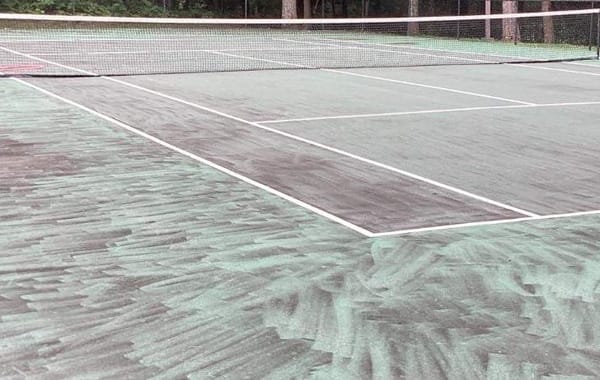
Stock Tips on a Surface Cleaner
The single fastest way to destroy a court. A spinning bar running factory tips puts thousands of PSI on the coating and leaves arc marks that never fade. The machine is not the problem. The tips are.
Algae, Moss & Mildew
Organic growth holds moisture against the coating, turns glassy when wet, and works into hairline cracks where the freeze-thaw cycle widens them every winter.
Birdbaths & Standing Water
Low spots that hold water after rain become the first places algae colonizes and the first places the coating fails. Cleaning reveals them. We flag every one we find.
Wrong Chemistry
Acid based cleaners and hot mixes fade court color and can etch the coating. Dilution on a painted sport surface is not the same as dilution on a roof or a sidewalk.
Stiff Brushes & Wire
Aggressive bristles do the same thing high pressure does, just slower. Soft bristle agitation lifts dead growth without dragging sand out of the paint.
Unprotected Landscaping
Runoff from a court flows straight into the perimeter beds. We pre-wet and rinse surrounding plantings and use biodegradable detergents throughout.
Do this yourself, right now
The Silica Sand Traction Test
Before you book tennis court cleaning from anyone, spend sixty seconds on your own court. This tells you whether a previous contractor already took sand out of it. You do not need us to run it, and you do not need any tools.
Find a protected spot
Put your flat palm on the court in the middle of a service box, near the net. This area sees the least aggressive cleaning and the least foot traffic wear. Drag your hand slowly a foot or two. Remember what it feels like.
Find a rushed spot
Now do the same near the fence line, in the corners, and along the outside edges of the apron. These are the places a crew working fast overlaps passes and lingers. Same palm, same slow drag.
Compare the two
The protected spot should feel like fine sandpaper. If the rushed spot feels noticeably smoother, slicker or glassier, sand has been removed from that area and the traction there is already reduced.
Two more tells worth knowing
Look for arcs. Stand at one baseline in low morning or evening sun and sight down the court. Overlapping circular arcs or straight banding in the color are surface cleaner tracks. Once you see them you cannot unsee them, and they are permanent.
Watch for gloss, not dullness. Most people assume a damaged court looks worn out. It does the opposite. Sand loss makes a court look shinier and lighter in the traffic areas, which is exactly why so many owners compliment the crew that just ruined their surface.
Interactive
The Court Surface Test
Pick a tennis court cleaning method, then drag across the court. Watch what each one does to the algae, and to the silica sand sitting underneath it.
Illustration of surface behaviour, not a lab measurement. The physical outcome it shows is real: sand loss from a cured color coat is permanent.
Notice that all four methods eventually get the court clean. That is the trap. Clean is easy. Clean without taking the surface with it is the actual job.
The part nobody explains
The Nozzle Math
Every honest conversation about tennis court cleaning comes down to this number. Pressure at the surface is set by the orifice size of the tips, and it falls with the square of that size, so doubling tip size cuts pressure to a quarter. Move the sliders and watch what a tip change does.
What this means on your court
A 4 GPM machine on a two-tip surface cleaner running 2.0 tips puts roughly 4,000 PSI on the coating. That is the default a lot of rigs arrive in, because it is what you want for concrete. Swap to 4.0 tips and the same machine drops to about 1,000 PSI. Go to 5.0 and you are near 640.
So when a contractor tells you they will be careful, that is not an answer. Ask what tips are in the bar and what pressure that puts on the surface. If they cannot tell you, they have not thought about it, and your court is the experiment. This one question filters most tennis court cleaning bids in about four seconds.
Same court, same day
Two Crews, Two Outcomes
Two crews quote the same tennis court cleaning job. Both leave you a court that looks clean in the photo. Only one leaves you a court that still plays right in three years.
The left column is not a strawman. It is the most common way tennis court cleaning actually gets done in Middle Tennessee, because a surface cleaner on a court is fast and the damage does not show up until the next wet match.
Instant Range
Estimate Your Court Cleaning
Three taps gets you a real tennis court cleaning number. Send it over and we confirm on site, at no charge.
Add-ons are quoted on site and are not in the range above.
No obligation. We confirm every estimate on site before any work begins.
How we do it
Our Tennis Court Cleaning Process
Six stages of court-safe soft washing, built around one rule: nothing hits the surface at a pressure that could pull sand out of the paint.
Surface Inspection and Documentation
We walk the court before anything gets wet. Cracks, blisters, delamination, low spots that hold water, failing net posts and worn line paint all get photographed. You get told what we found, whether or not it changes the job.
Equipment Set for the Surface, Not the Truck
Tips get selected and pressure gets set for an acrylic sport coating before the first drop of water lands. This is the step that gets skipped, and it is the step that decides whether your court survives the cleaning.
Site and Landscape Protection
Perimeter beds get pre-wet, drains and any adjacent pool get covered or protected, and we set up so runoff goes where we intend it to. Biodegradable detergents throughout.
Low Pressure Chemical Application
A court-safe dilution goes down through a dedicated low pressure pump. It is calibrated for acrylic sport coatings, which are far more sensitive than a roof or a driveway, and it kills algae, mold and mildew at the root instead of just bleaching the top of it.
Soft Bristle Agitation Where Needed
Heavy buildup in the shaded corners and along the fence line gets worked with soft bristle brooms. Hand agitation only, no wire, no stiff bristles.
Controlled Rinse and Walkthrough
We rinse with pressure controlled at the valve, flushing the dead growth and cleaning solution off the court and away from the perimeter. Then we walk it with you. If something is not right, we stay until it is. That is what the 100% satisfaction guarantee means.
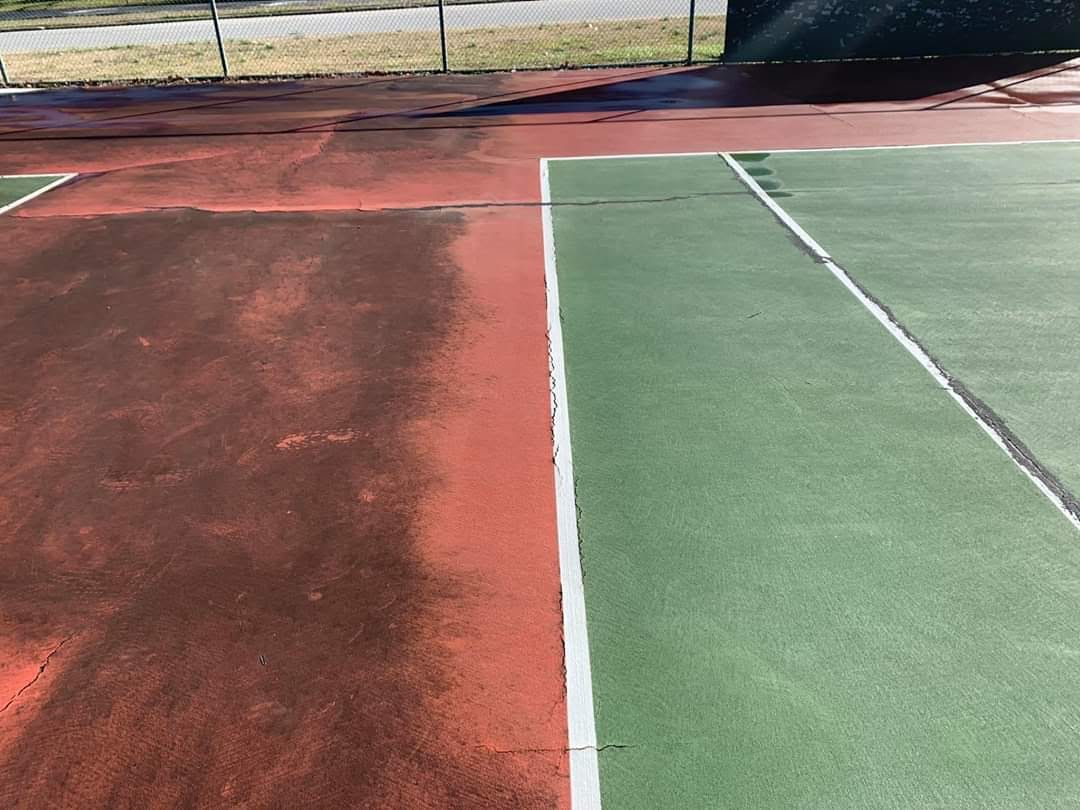
The finish
What a Properly Cleaned Court Looks Like
This is the standard every tennis court cleaning job we run is measured against. Not just clean, but clean with nothing left behind and nothing taken away.
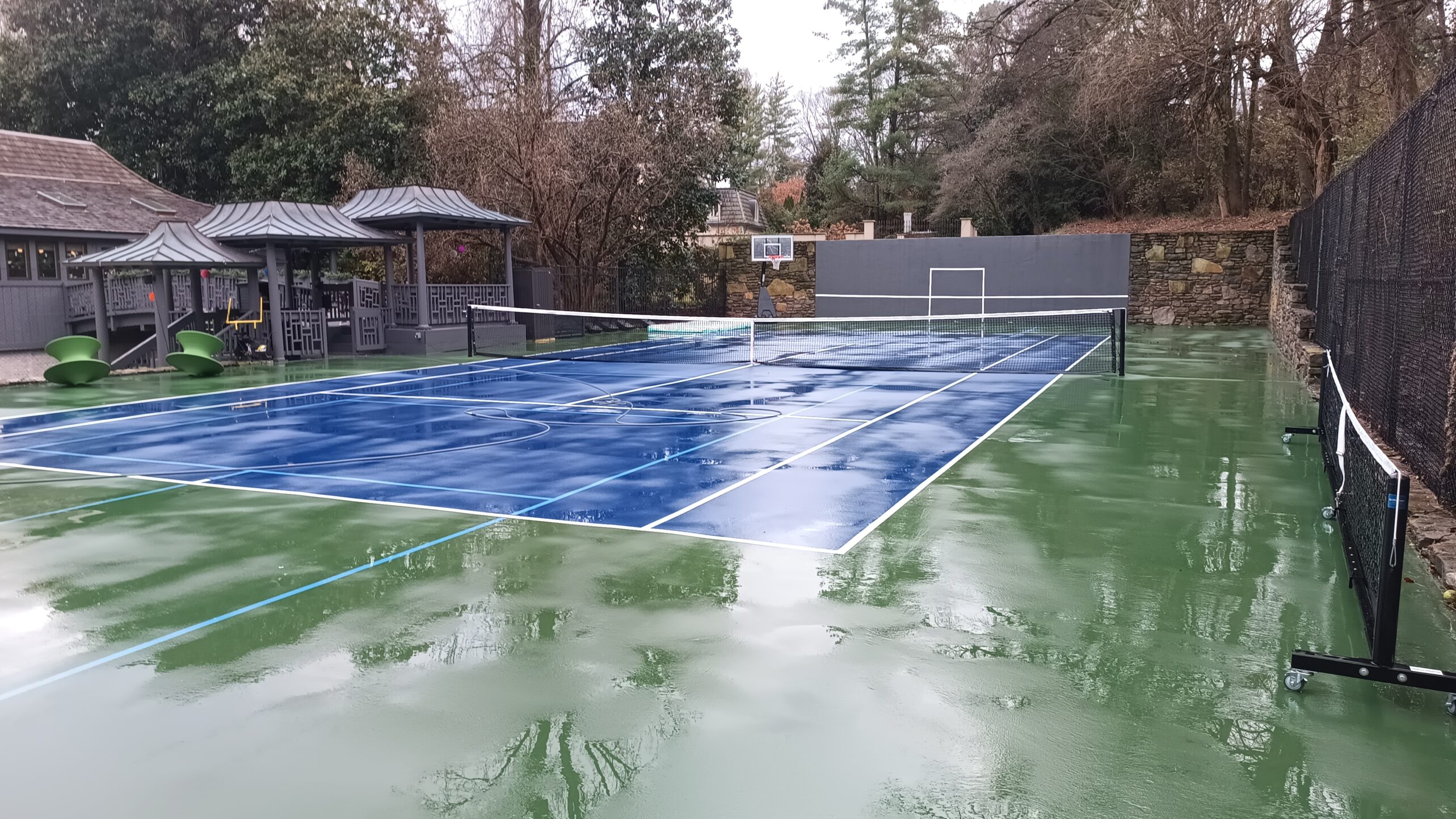
No soapy residue
This is the one most people never think to ask about. Surfactant left on a court is slick when it gets damp, so a crew that skips the rinse hands you a slip hazard that looks spotless. We flush until the surface runs clear.
No grime, no algae
Organic growth killed at the root rather than bleached on the surface, so it does not reappear four weeks later from roots that were never touched. Shaded corners and fence lines get the same attention as the service boxes.
No traction removed
Run the palm test on this court and the middle of the service box feels exactly like the fence line. The silica sand is where the manufacturer put it, the speed rating is unchanged, and there are no arc marks anywhere on it.
Safe to play immediately
No cure time, no closure period, no waiting for a coating to set. Because nothing was applied that has to stay on the surface, the court goes back into play as soon as we pull the equipment off it.
What we work on
Courts and Sport Surfaces We Handle
Tennis court cleaning is the core of what we do here, but every surface below gets its own dilution, its own dwell time and its own pressure setting. That judgment is the job.
Acrylic Hard Courts
The standard tennis surface across Middle Tennessee. Asphalt or concrete base under an acrylic resurfacer and sand-filled color coats. Low pressure only, always.
Cushioned Court Systems
Rubber granule layers under the color coat. Softer underfoot and less forgiving of pressure, since the cushion layer will tear where a hard court would only scour.
Pickleball Courts
Dedicated builds and courts striped over existing tennis. Smaller footprint, but the same acrylic and the same sand, so the same rules apply.
Outdoor Basketball Courts
Community, church and HOA courts. Usually neglected longer than tennis courts and usually the ones with the worst algae along the shaded baseline.
Modular Sport Tile
Snap-together polypropylene tile over concrete. Grime settles into the open grid, so these need flushing rather than surface scrubbing.
Fence Lines, Windscreens & Surrounds
Chain link, windscreens, bleachers, shade structures and the concrete walkways around the court. Cleaning the court and leaving a green fence never looks finished. Clubhouses on the same property usually need roof cleaning at the same time.
The detail
The Details Behind the Method
For facility managers, club boards and anyone who has been burned by a bad contractor before.
An acrylic color coat is applied as a slurry of pigment, binder and graded silica sand. The sand sits proud of the binder and creates a micro-texture across the entire surface. That texture is what your shoe grabs on a hard stop, and it is what puts a slight bite on the ball so the bounce is true instead of skidding.
Manufacturers specify sand grade by court speed. A slow court uses coarser sand, a fast court uses finer sand. When someone removes that sand with pressure, they have not just cleaned your court aggressively. They have changed its speed rating and taken away its footing, permanently, because you cannot put sand back into a cured coating. The only remedy is to apply new color coats over the whole court.
Pressure is not a dial you turn. On a given machine, pressure is what happens when a fixed flow of water is forced through a fixed hole. Make the hole bigger and pressure falls, hard. A nozzle's size number is defined as the flow in gallons per minute it passes at 4,000 PSI, so pressure works out to 4,000 times the square of GPM per tip divided by tip size.
The squared term is the whole story. On a 4 GPM machine with a two-tip bar, going from 2.0 tips to 4.0 tips does not halve the pressure, it quarters it, from roughly 4,000 PSI down to about 1,000. Step to 5.0 tips and you are near 640. This is why the same physical surface cleaner can be either a court killer or a reasonable tool depending on ten dollars worth of brass and thirty seconds of thought.
Two things this does not fix. Flow stays the same, so a bigger tip means more water on the surface, which matters near unsealed cracks and low spots. And the bar still spins, so mechanical dwell in one place will still mark a soft coating. Sizing tips up lowers the risk. It does not remove it, which is why chemistry stays our first tool on acrylic.
Tennis court cleaning removes organic growth, dirt and staining from a coating that is still intact. It restores the appearance and the traction that the algae was masking, and it is a fraction of the cost of resurfacing.
Cleaning cannot fix a coating that is already failing. If you have widespread peeling or delamination, cracking that has opened up past hairline, or areas where the color coat has worn through to the asphalt, you need a court resurfacer, not a cleaner. We will tell you that on the inspection rather than take the job. We do not resurface courts, so there is nothing in it for us either way.
A court is built with a slope so water sheets off it. When the base settles, low spots form that hold water after rain. Those are called birdbaths, and they are algae factories. They stay damp for days, they collect pollen and leaf litter, and they will be visibly greener than the rest of the court every single year.
Tree cover makes it worse in two ways. Less sun means slower drying, and leaf drop means constant organic food on the surface. A court in full sun with good drainage can go well past a year between cleanings. A court under mature hardwoods with two birdbaths will need attention every eight to ten months no matter what anyone does to it.
Most single courts are three to five hours and are back in play the same day once dry. For multi-court facilities we sequence court by court so you are never fully closed, and we can start early or work weekends around a league schedule.
For HOAs and property managers we provide a COI naming the association before we mobilize, we can post our own closure signage, and we send before and after documentation for the board packet. Annual recurring tennis court cleaning can be scheduled to a fixed month so it stops being a decision every year. If you manage buildings as well as amenities, our property management cleaning program covers the whole site on one schedule.
Court runoff goes somewhere, and on most properties that somewhere is a landscape bed or a pool deck. We pre-wet plantings before any chemical goes down and rinse them again afterward, cover or divert at drains, and use biodegradable detergents.
Net posts, windscreens, light poles, gate hardware and adjacent pool equipment all get accounted for before we start. On facilities with elevated light structures or shade sails, our aerial lift certification means we can reach and clean them properly rather than working from a ladder and calling it done.
Straight numbers
Tennis Court Cleaning Pricing
Priced per court, by condition. Not by the hour, and not by a number invented after we see the car in your driveway.
Maintained Court
Cleaned within the last 18 months. Light surface film, pollen and dust, minor growth at the edges. The annual service that keeps a court out of the expensive tiers.
Moderate Growth
Visible green in the shaded corners and along the fence line, staining across the low spots. Two to three years since the last proper clean.
Heavy Neglect
Widespread algae or moss, dark organic staining, surface that plays slick when damp. Extra dwell time, extra agitation, sometimes a second pass.
What moves the number
Ranges cover tennis court cleaning of the playing surface itself. Every estimate is confirmed on site at no charge before any work is scheduled, and the price you approve is the price you pay.
127+ 5-star reviews across platforms
What Middle Tennessee Says
Real Google reviews, tagged to the work they actually describe.
"this isn't some side gig... legit equipment"
Cleaned the house and roughly 1,500 square feet of pavers.
Shopped around and compared before choosing Southern Solution.
These reviews describe residential and commercial exterior cleaning work. None of them are about a tennis court, and we will not pretend otherwise. More about who we are, or read all reviews on Google.
FAQ
Tennis Court Cleaning Questions
No. We set pressure for an acrylic sport coating before we start, apply a court-safe dilution through a low pressure pump, and rinse at controlled pressure, so the silica sand that provides traction stays embedded in the color coat. Low pressure chemical cleaning is the method court surfacing manufacturers recommend.
The tool is not the problem, the pressure at the coating is. Nozzle tips set that pressure, and it falls with the square of tip size, so a two-tip bar on a 4 GPM machine drops from roughly 4,000 PSI on 2.0 tips to about 1,000 PSI on 4.0 tips. Sizing tips up makes an enormous difference. It still does not remove the risk from mechanical dwell and higher water volume on a soft coating, which is why chemistry stays our first tool on acrylic. If a contractor cannot tell you what tips are in their bar, that is your answer.
We price per court by condition. A maintained court starts around $800. A court with moderate growth runs $950 to $1,200, and a heavily neglected court runs $1,200 to $1,500. Facilities with multiple courts pay a lower rate per court. Fence lines, windscreens and surrounding concrete are quoted separately on site.
Run your palm across the court in the middle of a service box, then near the fence line and corners. The protected area should feel like fine sandpaper. If the edges feel smoother or slicker, sand has been removed. Also sight down the court in low sun and look for overlapping circular arcs, which are surface cleaner tracks. Counterintuitively, damaged areas look shinier and lighter rather than duller.
Once a year in the Middle Tennessee climate. Courts in full sun with good drainage can sometimes stretch longer. Courts under tree cover, courts that hold water in low spots, and courts near heavy pollen sources typically need service every eight to ten months to stay safe and playable.
Most single courts take three to five hours. Multi-court facilities are usually a single day, sequenced so you are never completely closed. Because we rinse until no soapy residue is left and nothing is applied that has to cure, the court is safe to play on as soon as we pull our equipment off it. There is no closure period.
No. Cleaning removes organic growth and staining from a coating that is still sound. Cracking, delamination, peeling color coat and faded lines are resurfacing work, which is a different trade. We document what we find during inspection and tell you plainly if cleaning is not the right spend for your court.
Yes. Dedicated pickleball courts, pickleball striped over tennis, outdoor basketball courts, cushioned court systems and modular sport tile. Each surface gets its own dilution and dwell time. We also clean the fence lines, windscreens, bleachers and the concrete around the court.
We plan for runoff before anything goes down. Perimeter plantings are pre-wet and rinsed again after, drains are covered or diverted, adjacent pool equipment is protected, and we use biodegradable detergents. Protecting the property around the court is part of the job, not an add-on.
Yes. We are insured and provide a certificate of insurance on request, and we can name your association or management company before we mobilize. We are also aerial lift certified, which matters on facilities with elevated light structures or shade sails. Southern Solution has been in the trade since 2011 and is veteran owned.
Based in Middle Tennessee. We regularly clean courts in Nashville, Franklin, Brentwood, Bellevue, Oak Hill, Nolensville, Spring Hill, Mount Juliet, Hendersonville, Columbia and Dickson, and we serve Williamson, Davidson, Dickson, Cheatham, Hickman, Maury, Montgomery, Humphreys and Houston counties. Tennis court cleaning is one of several exterior cleaning services we run across the same territory.
Get Your Court Looked At
Send us the details and we will confirm a firm tennis court cleaning price on site at no charge. If cleaning is not what your court needs, we will tell you that instead of selling you something.
Southern Solution LLC · Based in Middle Tennessee · office@southernsolutiontn.com · Insured, COI on request · Aerial lift certified